Godspeed
The LuminariesGodspeed is a barque that serves first as a means of passage and then as contested property: its voyages carry Walter Moody into the story, while its transfers, wreck, cargo, and insurance claims connect Francis Carver to Alistair Lauderback, Crosbie Wells, and a fortune in gold. A stout craft with a sharply raked bow and a painted-oak eagle for a figurehead, the ship becomes more than a setting. Its unstable ownership makes it a material record of fraud, and its wreck turns hidden cargo into evidence.
Vessel and early ownership
Godspeed belonged to Alistair Lauderback, a shipowner who also held political ambitions. He owned four vessels: the clipper ships Virtue and Corona Australis, the schooner Lady of the Ballroom, and the barque Godspeed. He had leased ships on charter, but the personal risks of that arrangement led him to seek an established shipping firm able to insure them at a reasonable rate. In naming his fleet to Thomas Balfour, he recited the vessels in a fixed order, as though listing members of his family; Godspeed was the last of the four.
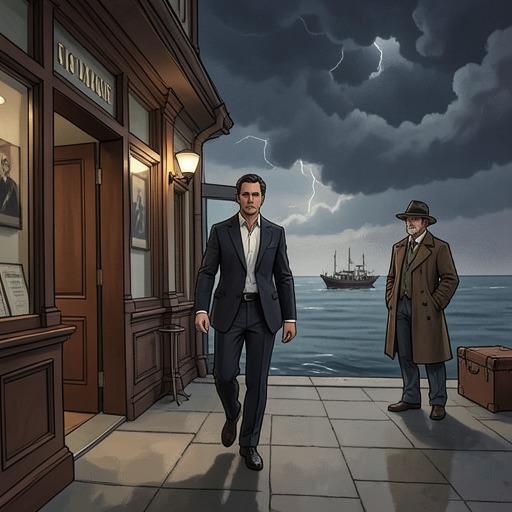
Walter Moody sailed aboard Godspeed from Port Chalmers toward the goldfields. The route bent north through the narrow strait between two seas before turning south again, a hairpin shape on the map. Moody had only a cramped space below decks, and the foul, close hold drove him to spend most of the journey above it, hunched beneath the gunwales with his leather case held against him. Because he sat with his back to the view, he saw little of the coast the ship passed. The vessel thus brings him to Hokitika while also enclosing him in the restricted, unsettled perspective from which the novel’s mysteries first appear.
When Godspeed reached the Hokitika roadstead months later, Balfour recognized its name as one of Lauderback’s ships. He introduced himself to its master, Francis Carver, and formed a cordial, largely formal connection with him through their shared association with the vessel. Privately, Balfour regarded Carver as thuggish and suspected him of being a crook, but found him uninteresting rather than impressive. That contrast matters: the ship’s connection to Lauderback offers Carver a respectable point of entry into Hokitika’s shipping community, even as Balfour remains alert to the difference between a legitimate affiliation and the man’s character.
Transfers, blackmail, and the gold
The account of Godspeed’s ownership becomes deliberately tangled. Lauderback later described Carver’s seizure of the ship as the result of blackmail. Carver made him consider how the evidence would look to outsiders: Lauderback had courted Lydia Wells while she posed as Carver’s wife, had taken a fortune from a man, and appeared ready to send undeclared gold offshore. Such circumstances could expose him to charges involving adultery, theft, conspiracy, and customs evasion. Carver’s demand, Lauderback said, was the ship. Lauderback later declared his intention to expose Carver and recover Godspeed, but Carver’s control of the vessel proved more durable than that resolve.
A later reconstruction adds another layer to the transfer. In May 1865, Crosbie Wells returned to Dunedin, cleared several thousand pounds’ worth of ore from a safe, and used the fortune to buy Godspeed. Wells entrusted the ship and its operation to Carver, then left for Hokitika without telling his wife where he was going or what he intended. The vessel therefore stands at the center of overlapping transactions: Lauderback’s account identifies Carver’s coercion, while the later account traces Wells’s purchase and Carver’s role in operating the ship. In the courtroom, Moody identifies Carver’s methods as extortion, impersonation, and fraud, linking the acquisition of Godspeed to the theft of Wells’s much larger fortune.
The stolen wealth had itself passed through several hands and forms. Roughly nine months before the present-day events, Carver had cheated Lauderback out of Godspeed and subsequently lost the shipping crate used to force Lauderback’s hand. The crate held a trunk containing about four thousand pounds in pure gold, carefully sewn into the linings of five dresses. Lydia Wells had made the dresses while posing as Carver’s wife. When the crate vanished, neither its disappearance nor the exact route of the gold was immediately clear. The ship’s later wreck would reveal that the missing Lauderback crate had been loaded aboard Godspeed when it last left Hokitika.
Wreck and recovery
Godspeed ran aground on the Hokitika Bar. The ship rolled, its mainmast cracked, and surf entered through the hatches before it rolled again and went down. The wreck gave a possible explanation for Moody’s earlier account of a bloodied figure aboard the vessel. He had wondered whether Emery Staines was still on Godspeed, perhaps with Carver, beyond the river mouth. After the wreck, a messenger’s report led Moody to reason that, if Staines had been aboard, his body would have been found among the cargo. The sinking seemed to close off that possibility, although the ship’s fate did not resolve every question about what had happened before it went down.
Recovery was slow and costly. Over three weeks, two large tugboats moved the barque into shallower water. Its hull was then lifted onto rollers and brought flush with shore; at low tide, Clydesdales and a winch hauled it clear of the surf onto the Hokitika spit. All three masts had broken off at their bases, leaving the wreck without sails or rigging. Once its cargo and fittings were removed, the vessel was to be dismantled and sold in pieces for salvage and repair. Benjamin Löwenthal, who passed the wreck after it had been hauled ashore, saw it as though it had fallen from the air; the ship’s broken form made its removal from the sea seem almost like the aftermath of a fall.
Carver managed the wreck’s disposal in public view. He lodged at the Palace Hotel and met shipping delegates, supplied the Harbourmaster with a cargo inventory, settled accounts, and rowed out to the wreck with shipwrights and salvage vendors. He announced that the hull would be dismantled and its parts sold at auction through Glasson & Rowley Salvage, barring advance sales or private arrangements. This openness complicated the suspicion that he might be concealing a crime aboard the ship. Yet his straightforward handling of salvage did not make his ownership claims reliable; it gave him the appearance of ordinary business while he prepared to make a further claim against the ship’s insurance.
Insurance and contested identity
Godspeed carried protection and indemnity cover through the Garrity Group, a shipowners’ mutual association to which Lauderback belonged. The arrangement was not simply conventional insurance: the yearly contributions created a fund against certain liabilities, including expenses arising from the wreck. Each of Lauderback’s ships had close to a thousand pounds in credit. Carver could legally seek those funds to help cover the cost of removing Godspeed from the spit, provided he filed before the middle of May, when a year would have passed since the vessel’s sale and Lauderback’s legal obligation connected to it would end.
A letter Carver sent to John Hincher Garrity presented Crosbie Wells as Godspeed’s recently deceased owner and Carver as the former operating master settling the dead man’s affairs by proxy. It asserted that Wells had inherited the existing policies from Lauderback and requested funds for wreck removal, accompanied by records of expenses, deeds of sale, receipts, and inventories. The documents did not settle the matter. Carver’s copy of the bill of sale bore a signature that could be read as Francis Wells, while Moody later pointed to a version signed C. Francis Wells. The lettering allowed a C to resemble the large loop of an F, and a fortuitous ink mark further complicated interpretation. The paperwork turned identity into a question of handwriting: the same name could appear to establish a legitimate owner or conceal the person who had taken his place.
Aubert Gascoigne investigated the claim and concluded that Carver was entitled to seek the funds under the apparent terms of his letter. Since the letter represented him as acting for a dead owner and no evidence then available disproved that account, Gascoigne saw no clear legal basis for Lauderback to block the payment. He informed Lauderback that Carver was attempting to draw on the protection and indemnity scheme, but the politician could not easily challenge either the ambiguous signature or the approved claim. Thomas Balfour ultimately advised him that Carver had bested him in that round; Garrity had approved the transaction, and Lauderback’s anger could not undo the documents.
Carver later complained that the costs of the wreck would leave him a thousand pounds out of pocket, even after the insurance claim. On the sixteenth, he married Lydia Wells. The day after the wedding, he received a substantial payment from the Garrity Group, paid his creditors, and saw the remaining copper plating removed from Godspeed’s hull before its bones were released for salvage. He left the Palace Hotel and settled with Lydia at the Wayfarer’s Fortune. In this ending, the ship is physically dismantled and its financial claim concluded, but the resolution is compromised: Carver’s success rests on a history of coercion and false identity that the novel has brought into view.
Narrative significance
Godspeed’s story follows the transformation of a vessel from named possession to instrument of leverage, contested evidence, and salvage. Its name first identifies one of Lauderback’s ships; its passage carries Moody to Hokitika; its wreck interrupts speculation about Staines and exposes the missing crate; and its insurance policy gives Carver another opportunity to profit from disputed ownership. The ship’s changing legal status is as consequential as its physical damage. A barque can be purchased, seized, represented as belonging to a dead man, and made the basis of a claim whose apparent validity depends on the signature attached to it.
The recovered crate also shows how the vessel gathers separate plots into a single material point. The gold was concealed in dresses, packed into a trunk, placed in a shipping crate, lost, and finally found in Godspeed’s cargo. Each change of container and custody changes what the wealth can mean: private fortune, blackmail evidence, missing property, or a reason to seek indemnity. When the ship itself is broken up for salvage, its physical parts become saleable remnants, while its cargo and papers continue to bear on the identities of the living. Godspeed is therefore not merely the means by which characters travel; it is the unstable property through which the novel tests the distance between ownership, possession, and proof.